
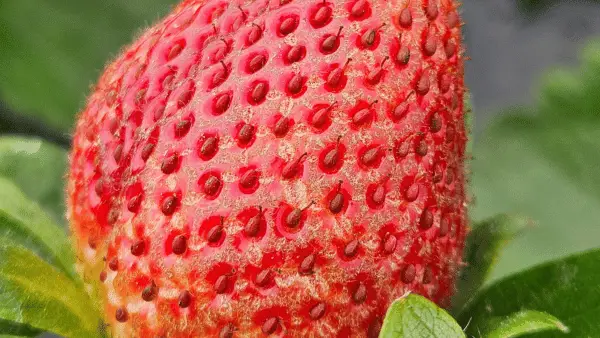
Intonsa: A New Thrips Threat for Australian Growers
Frankliniella intonsa (Intonsa or Eurasian flower thrips) is a recently detected thrips species in Australia. This pest is widespread across the Americas, Europe, Asia and New Zealand.
While its pathway into Australia remains unknown, it was first formally identified in Queensland in April 2026 from strawberry and Rubus crops.
Biological Services has been involved since the earliest stages of the outbreak, working with growers to apply Integrated Pest Management approaches, with trials showing pesticides are largely ineffective.
Identification
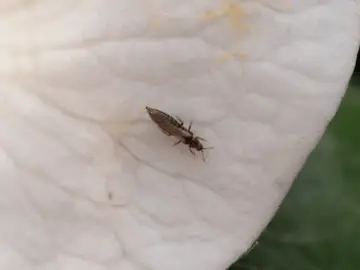
Intonsa closely resembles Western Flower Thrips (Frankliniella occidentalis, WFT) and can vary in colour depending on its diet and environment.
Key identifying features include:
- Large, dark-coloured adult females and smaller brown adult males, similar in appearance to WFT.
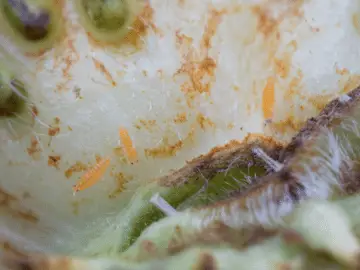
- Larvae are typically bright yellow to orange and are similar in size to WFT larvae.
- Pre-pupal larvae are often found beneath the fruit calyx, unlike WFT.
The most reliable distinguishing feature is the pair of setae behind each eye, which are much shorter than in WFT. However, this can be difficult to see without magnification. We recommend professional identification whenever unusually high or unseasonal thrips pressure is observed.
Lifecycle and ideal conditions
Intonsa thrives in humid conditions, with optimum temperatures between 20°C and 25°C, but remains active from 10°C to 36°C.
Under favourable conditions, development from egg to adult takes just 8 to 13 days. Females can lay up to 200 eggs and live for 18 to 35 days, while males live for 11 to 37 days. Females can also reproduce without mating, allowing populations to increase rapidly.
Damage
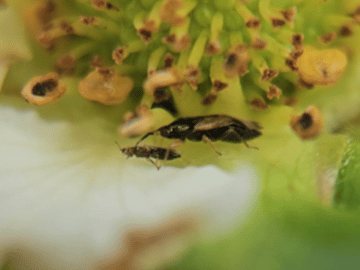
The most significant damage this season has been observed in strawberry flowers and fruit. However, Intonsa has a broad host range similar to WFT and is known to transmit several economically important viruses, including Tomato Spotted Wilt Virus (TSWV).
“This challenge might not be unique to QLD berry crops,” says James Altmann, Director of Biological Services. “We are particularly concerned about Intonsa spreading into the interstate berry production areas. Overseas, this pest is recorded as a pest in a range of indoor and outdoor fruits, vegetables and ornamentals.”
Adam Billsburough, Biological Services Consultant for Queensland and Tasmania, adds, “The speed and scale of the outbreak caught growers and agronomists by surprise.”
In strawberries, damage is similar to WFT and includes bronzing and surface scarring on green fruit, as well as feeding damage to flower stigmas, styles and petals.
Silvering damage has also been observed on ripening raspberry fruit. While little damage was seen on blackberry drupelets, high Intonsa populations can cause flower abortion and uneven drupelet development. In other horticultural crops, Intonsa could cause damage similar to WFT. However, field observations suggest higher Intonsa populations may be required to cause equivalent damage levels.
Control options
Biological control provided the most effective and longest-lasting suppression in our trials.
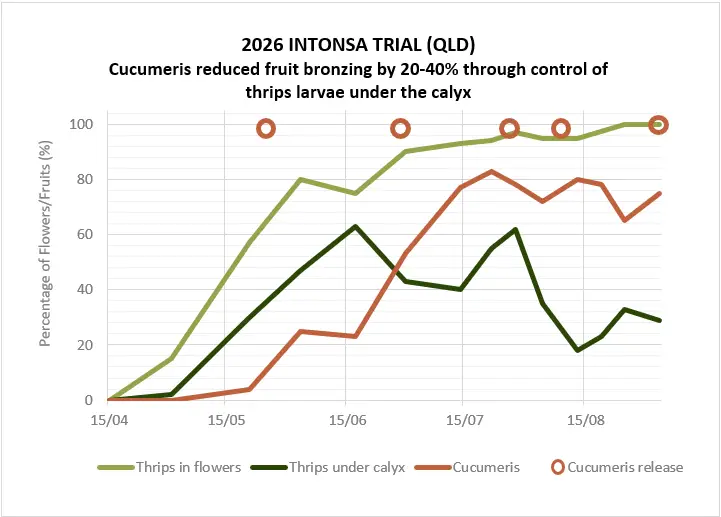
Regular high-rate releases of Neoseiulus cucumeris (Cucumeris) reduced thrips larvae populations by 20-40% for up to four weeks. Repeat releases were required to keep predator numbers high because it only targets immature thrips. Despite intensive release programs, some bronzing damage still occurred.
This highlights the importance of thorough releases and achieving good crop-wide coverage rather than relying on beneficial insects to spread naturally through the crop.
Orius also showed strong potential, particularly when combined with Cucumeris. Trial blocks with established Orius populations consistently recorded the lowest thrips damage.
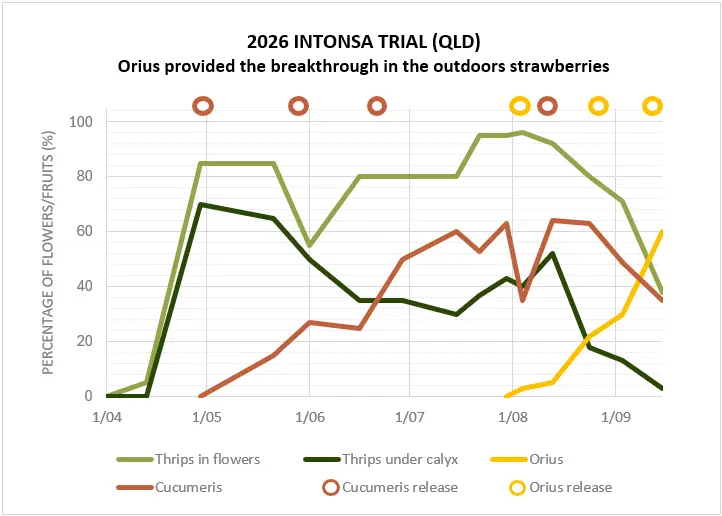
“In future seasons we believe early establishment of Orius will be key to obtaining maximum control in QLD strawberries,” says Lachlan Chilman, Director of Biological Services. “Regular releases of Cucumeris will still be required to support control, especially while Orius is establishing.”
Chemical controls were generally ineffective.
Cyantraniliprole, flonicamid, isocycloseram, methomyl, spinetoram and sulfoxaflor provided only between 5-20% control in any application.
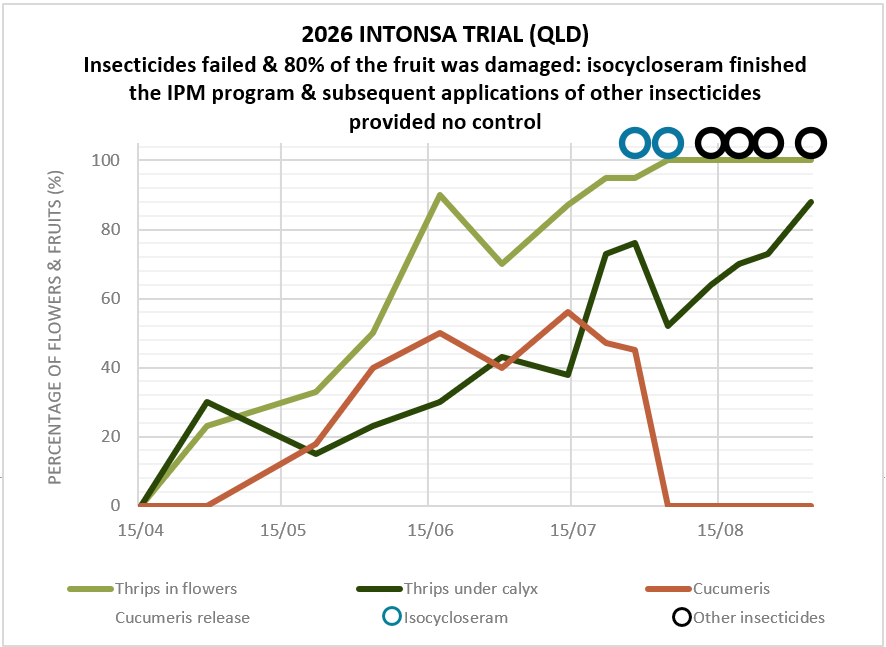
“This result surprised us,” says Jake Byrne, Team Leader for Queensland, New South Wales and Tasmania. “The lack of control observed across several insecticide groups suggests Intonsa may have originated from an overseas production system where many of these products have already been used extensively.”
Intonsa populations rebounded after all treatments, quickly returning to previous levels or higher. As resistant populations persist between crops and seasons, the effectiveness of these products is likely to continue to decline.
The newly registered insecticide isocycloseram is also highly toxic to beneficial insects and bees.
Its long residual activity can disrupt IPM programs for more than four months, limiting biological control options for the remainder of the season and increasing reliance on largely ineffective chemical controls. Growers utilising IPM programs are advised to avoid use of this product in the early stages of the growing season.
Summary
Intonsa closely resembles WFT in both appearance and damage. However, its ability to remain active under cooler conditions means it may appear earlier in crops than WFT. Early releases of beneficial insects remain the most effective management strategy.
Our trials are ongoing. We recommend you work closely with your IPM consultant to establish beneficial populations before pest pressure becomes difficult to manage and seek advice before utilising any pesticides that might be detrimental to beneficials in your programs.
To learn more about using biological controls for Intonsa, or broader grower benefits of Integrated Pest Management, contact us.