
Two-Spotted Mite can cause significant damage to greenhouse crops, with infestations spreading quickly under warm, dry conditions. Predatory mites offer an effective biological control option, but success depends on early detection, good crop management and the strategic use of compatible miticides. In this article, Biological Services’ Stephanus Malherbe and James Altmann share practical guidance to help you better manage Two-Spotted Mite in greenhouse crops with an Integrated Pest Management (IPM) program.
A Global Menace: Two-Spotted Mite in Protected Crops
The Two-Spotted Mite (Tetranychus urticae, TSM) is a serious pest of protected and outdoors crops worldwide. Highly polyphagous, it feeds on a broad range of hosts—from greenhouse vegetables like tomatoes, cucumbers and capsicums, to ornamentals such as chrysanthemums, orchids and roses, and even berries including strawberries, raspberries and blackberries. It can also infest tree crops such as apples, peaches, and almonds. Tomatoes are particularly vulnerable, as their natural plant chemistry makes it difficult for predatory mites to establish and persist.
Recognising TSM Activity and Damage
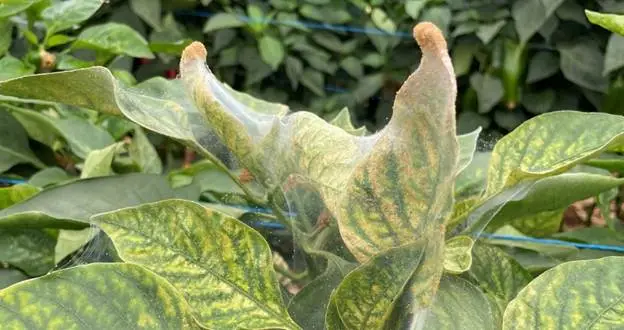
TSM typically infest the undersides of leaves, piercing plant cells and sucking out their contents. Affected cells turn yellow, and this damage often appears on the upper leaf surface as small white-yellow speckles. As infestation progresses, leaves may turn completely yellow, lose their photosynthetic capacity, and die—sometimes leading to the death of the entire plant.
Both nymphs and adults produce webbing. In severe infestations, plants can be entirely covered in webs teeming with mites, resulting in permanent stunting or plant death (see Figure 1).
Greenhouses: A Perfect Sanctuary for TSM
Why is TSM so common in greenhouse crops? Greenhouses provide ideal conditions: warm, dry environments with no rain or dew, high planting densities, and abundant food. They also exclude natural predators. Mites spread easily between plants via the ground, crop wires, or even air currents. Adult mites can release themselves from plants using silk threads and travel on wind, machinery, clothing, or birds.
Jake Byrne, an Integrated Pest Management (IPM) Consultant based in NSW, recalls: “I still remember the day a crop worker took me up on the crop trolley, high above the crop, to show me how mites were moving along the wires. They were using the wires as highways and spreading throughout the crop.”
TSM are also excellent at overwintering—surviving on old plant debris, inside greenhouse structures, and even in soil or growing media. Freezing temperatures don’t kill them.
Practical Tip: Always scout or work in heavily infested areas last. Mites can easily be spread via clothing and equipment, infesting the entire crop.
Cultural Control in Action: Simple Steps to Suppress Spider Mites
Spider mites thrive on a wide range of broadleaf weeds, especially nightshades. Host weeds both inside and outside of structures should be controlled at all times to reduce infection sources. Outbreaks often occur when plants are stressed—due to heavy fruit loads (as in capsicums) or poor agronomic practices like over-irrigation. Healthy plants are more resilient to TSM.
Hot, dry conditions favour mites, while humidity supports predatory mites used in IPM programs. Maintaining humidity in the crop canopy can suppress TSM and boost beneficial mite activity.
Practical Tip: On hot days or during heatwaves, briefly run overhead sprinklers to dampen the crop—this works best when predatory mites are already established. Persistent hotspots can be treated with a watering can or backpack sprayer.

Figure 2. The impact of temperature on TSM deevlopment.
Biological Controls: Fighting Fire with Fire
Predatory mites are the frontline defence against TSM in greenhouse crops. They consume all life stages of TSM—including eggs.
- Phytoseiulus persimilis (Persimilis) is the cornerstone of global IPM programs. It can outbreed TSM across a range of temperatures (see Figure 3), making it ideal for curative treatments.
- Neoseiulus californicus (Californicus) is a cosmopolitan species better suited to hot, dry conditions. It performs best at low TSM densities and is ideal for preventative use.
These two species are often used together in IPM programs. Early introduction of predators is critical—they need time to establish and spread. In challenging conditions (e.g. heatwaves), IPM-compatible miticides may be used to reduce TSM numbers and give predatory mites a chance to catch up.
In tomato crops, controlling TSM with predatory mites typically requires frequent releases, which can be costly. However, the polyphagous whitefly predator Nesidiocoris tenuis has proven effective in suppressing TSM. Lachlan Chilman, Director at Biological Services, explains: “In Australia, we generally don’t see TSM problems in tomato crops where Nesidiocoris have established.”
Effective crop scouting underpins successful IPM. Early detection allows timely release of predators and monitoring of control progress, enabling corrective actions such as spot-sprays or additional releases.
Other beneficials like Stethorus ladybirds and Six-Spotted Thrips also prey on TSM. Native midges, lacewings, Orius tantillus, Neoseiulus cucumeris, and Typhlodromips montdorensis can also feed on spider mites, but Persimilis and Californicus do the heavy lifting.
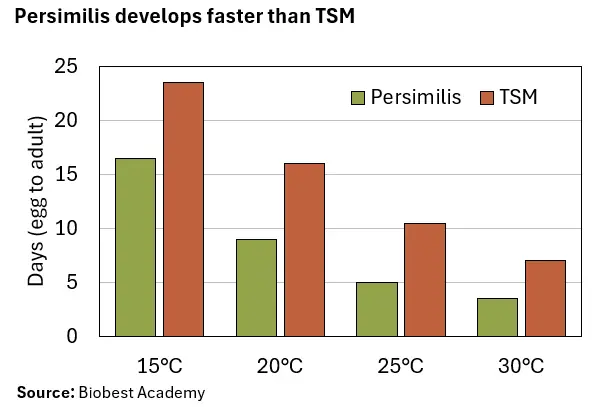
Figure 3. Phytoseiulus persimilis outbreeds TSM.
Resistance Risks: Smarter Miticide Use in IPM Programs
TSM rapidly develop resistance to miticides. Many older products are now ineffective and are often harmful to beneficials used in IPM programs. IPM-compatible miticides are required from time to time, but they should support – not replace – biological controls.
James Altmann, Director at Biological Services, emphasises: “These ‘soft’ miticides shouldn’t be used as a standalone solution.” Anita Marquart, IPM Consultant in Virginia, adds: “We still see some growers spraying miticides two to three times a week in summer. That destroys a good product and causes resistance. It makes success harder for everyone.”
Proper application is essential. These miticides are not systemic, so thorough coverage is critical, especially to the undersides of the leaves. Use adequate water volumes and avoid rushing. If using a spray machine or robot, ensure it’s not moving too fast. Poor spray jobs waste resources, promote resistance, and often require repeat applications.
TSM are sometimes confused with broad mites, which belong to a different family (Tarsonemidae vs Tetranychidae) and differ in size and anatomy. Some miticides effective against TSM won’t work on broad or eriophyid mites.
Cezar Moraes, Team Leader in WA, advises: “You can avoid identification errors by having your crops monitored by experienced crop scouts or IPM consultants.”
Final thoughts
Two-Spotted Mite is a persistent and damaging pest, but it can be managed effectively with a proactive, integrated approach. Early scouting, cultural hygiene, biological controls, and strategic use of IPM-compatible miticides form the foundation of successful management.
For more information, contact Biological Services on 08 8584 6977, email info@biologicalservices.com.au, or visit www.biologicalservices.com.au and leave a comment for the team to contact you.
This article first appeared in the Summer 2025 edition of Soilless Australia.